
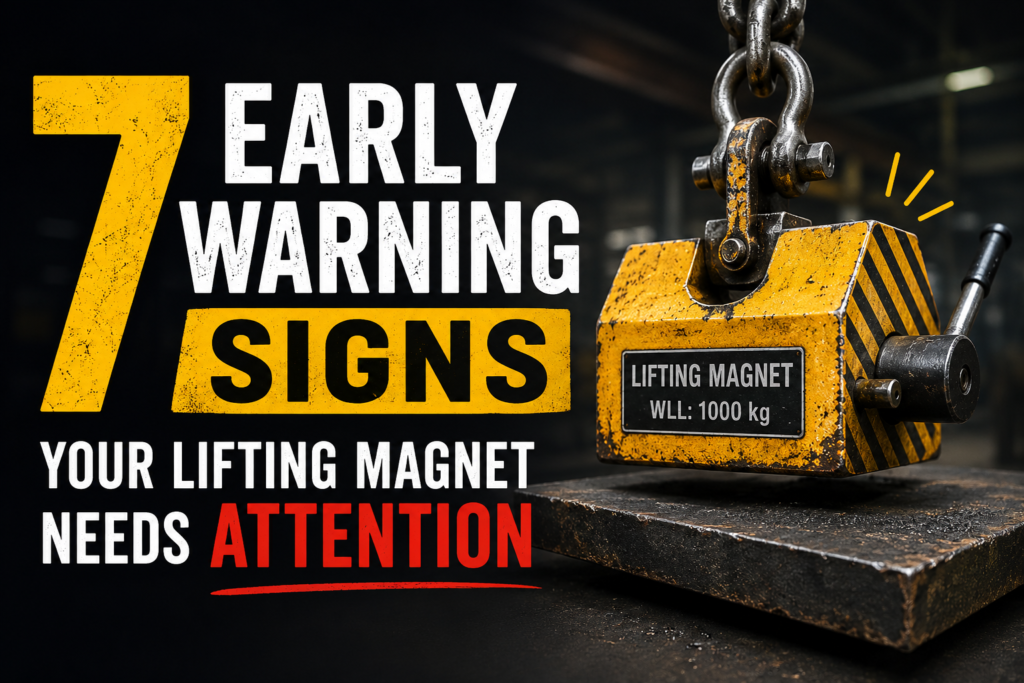
Most lifting magnet failures don’t happen overnight. They build gradually, through small, easy-to-miss signs that get overlooked until the day the magnet stops working altogether. By then, what could have been a simple service visit turns into an emergency repair, a production stoppage, and in some cases, a safety incident.
The good news is that electromagnets almost always tell you something wrong before they fail completely. You just need to know what to look for. Here are seven warning signs that should prompt a service call, not a wait-and-see approach.
1. Reduced Lifting Capacity
If your magnet is struggling to lift loads it used to handle without issue, or if it’s dropping material, it should be held securely. This is one of the clearest signs of coil degradation. Reduced lifting capacity rarely improves its own; it gets progressively worse until the magnet can no longer perform its job safely.
2. Overheating During Operation
A magnet that runs noticeably hotter than usual shows early signs of insulation breakdown. Heat is the primary driver of coil failure in industrial electromagnets, and a magnet that overheats today is a magnet that fails completely in the near future if left unaddressed.
3. Inconsistent Performance Across Shifts
Equipment that performs fine on one shift and underperforms on another is often dealing with an underlying electrical fault – loose connections, fluctuating voltage delivery, or early-stage coil damage. Inconsistency is rarely random; it usually has a root cause that gets worse with continued use.
4. Unusual Noise During Operation
Lifting magnets should operate with minimal noise. Buzzing, humming louder than usual, or any new mechanical sound during lifting or release is worth investigating. These sounds often indicate loose components, electrical irregularities, or developing mechanical wear.
5. Visible Physical Damage
Cracks in the housing, worn or pitted face plates, damaged terminals, or visibly frayed cabling are not cosmetic issues – they directly affect both performance and safety. Physical damage tends to accelerate other forms of wear, so addressing it early prevents a cascade of related failures.
6. Slower Response Time
A delay between activating the magnet and it is reaching full lifting force, or releasing a load, often points to electrical degradation within the coil or control circuit. This is a subtle sign that’s easy to dismiss normal wear, but it typically indicates the magnet is operating well below its rated efficiency.
7. It’s Been Over a Year Since the Last Service
Even an electromagnet that shows no obvious symptoms can be quietly degrading. Annual servicing exists precisely to catch issues before they become visible problems; coil wear, insulation fatigue, and calibration drift don’t always announce themselves until it’s too late. If it’s been over twelve months, it’s time for an inspection regardless of how the equipment seems to be performing.
What to Do If You Notice Any of These Signs
The right response to any of these warning signs is a proper diagnostic assessment, not a guess, and not waiting to see if it gets worse. A qualified service partner can inspect the coil, insulation, terminals, and mechanical components, run load testing to verify actual lifting capacity, and tell you exactly what needs attention before it turns into a breakdown.
Catching these signs early typically means a straightforward, lower-cost repair. Waiting until the magnet fails completely usually means a more extensive repair, unplanned downtime, and in some cases, a safety risk to your team.
The Bottom Line
Your lifting magnet is communicating with you well before it fails. Reduced capacity, overheating, inconsistent performance, unusual noise, physical damage, slower response, and time since last service are all signals worth acting on.
Plants that treat these signs as early warnings rather than ignorable quirks consistently experience fewer breakdowns, lower repair costs, and safer operations. The magnets that last longest are the ones that get attention before they ask for it.
Visit refluxmagnets.com or reach out via WhatsApp to book a diagnostic assessment.