
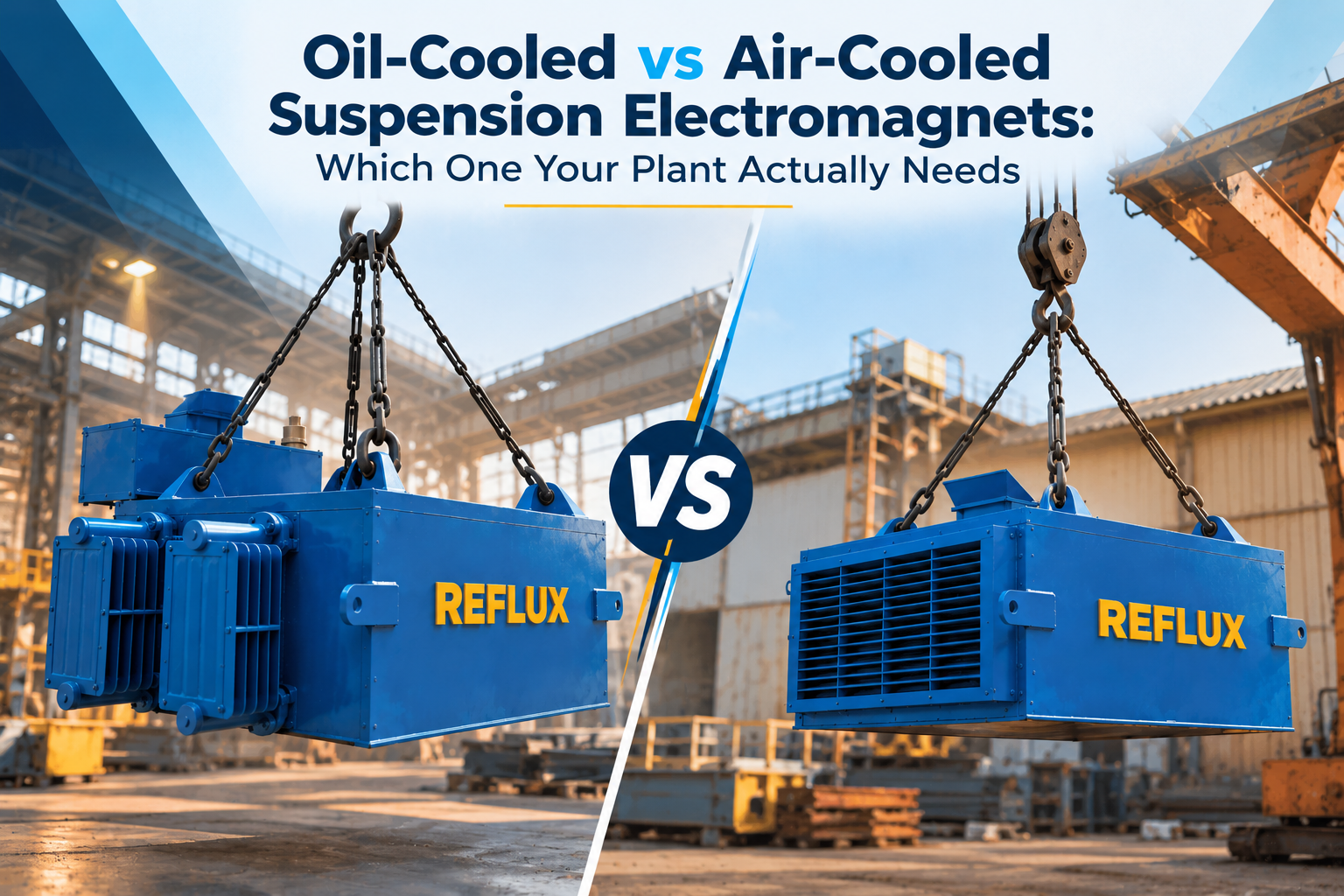
Suspension electromagnets do one job: pull tramp iron, bolts, rebar off-cuts, broken tools, stray metal out of material moving on a conveyor before it reaches a crusher, mill, or kiln and causes expensive damage. But the two main types, oil-cooled and air-cooled, are built for different operating conditions, and picking the wrong one is one of the most common (and costly) mistakes plants make when specifying a conveyor magnetic separator.
This isn’t a spec-sheet comparison. It’s the set of questions that actually determines which one belongs over your belt.
Start with duty cycle, not price
The single biggest factor is how long and how continuously the magnet runs. Air-cooled suspension magnets rely on natural convection to dissipate heat from the coil. That works well for intermittent or moderate-duty operation, but under continuous, high-duty-cycle running, coil temperature can climb faster than the ambient air can carry it away.
Oil-cooled units circulate insulating oil around the coil, which absorbs and dissipates heat far more efficiently. That makes them the standard choice for continuous, heavy-duty operation — large steel mills, cement plants, and high-throughput scrap processing lines where the magnet runs shift after shift with minimal downtime.
Ambient temperature changes the calculation
Plants near furnaces, kilns, or in naturally hot environments push air-cooled magnets closer to their thermal limits even at moderate duty cycles, because the surrounding air is already warm and can’t absorb much additional heat. In these environments, oil-cooled units hold a more stable operating temperature and are the safer long-term choice, even if the duty cycle alone wouldn’t strictly require it.
Cooler, well-ventilated environments or magnets mounted well away from heat sources give air-cooled units more headroom to perform reliably.
Burden depth and belt width matter more than buyers expect
A wider belt or a deeper burden of material means tramp metal has to travel farther, and fall from greater height, to reach the magnet’s effective field. This pushes plants toward larger, more powerful units, and larger coils generate more heat. Beyond a certain belt width and burden depth, oil cooling becomes less a preference and more a practical necessity to keep the coil within safe operating temperature.
As a rough guide: narrow belts with shallow burden and moderate duty cycle can often be served well by air-cooled units. Wide belts, deep burden, and continuous operation increasingly point toward oil-cooled.
Oil-cooled magnets add one maintenance task air-cooled units don’t have: monitoring oil level and condition over time. In exchange, they tolerate sustained heavy-duty running far better. Air-cooled units are lighter, generally simpler to install and service, but need closer attention if you’re running them near their thermal ceiling.
Self-cleaning vs manual: a separate decision
Independent of the cooling method, you’ll also choose between self-cleaning and manual-clean designs. Self-cleaning units use a moving belt to continuously discharge collected tramp iron, which suits high-volume operations where manual clearing would mean frequent stoppages. Manual-clean units are simpler and lower-cost, and work well where tramp iron accumulation is lighter or intermittent — you clear the magnet face on a schedule or as needed.
This choice pairs with your cooling decision rather than replacing it: a high-duty-cycle line with heavy tramp iron load often ends up specifying oil-cooled plus self-cleaning together.
A simple way to decide
Ask these four questions in order:
- Is the magnet running continuously, shift after shift, or intermittently?
- Is the surrounding environment already hot near a kiln, furnace, or in a poorly ventilated area?
- How wide is the belt, and how deep is the material burden?
- How much tramp iron volume are you realistically pulling out per shift?
If most answers point to “continuous, hot, wide/deep, high volume,” oil-cooled is very likely the right call. If your operation is lighter on all four, air-cooled will very likely serve you well at a lower installed weight and simpler upkeep.
Frequently Asked Questions
Which is more efficient: oil-cooled or air-cooled suspension electromagnets?
Oil-cooled units dissipate heat more efficiently and handle continuous, heavy-duty operation better. Air-cooled units are efficient enough for intermittent to moderate duty cycles, especially in cooler environments.
Can an air-cooled suspension magnet be used in a hot plant environment?
It can, but high ambient heat reduces its thermal headroom faster than in a cooler setting. In consistently hot environments, oil-cooled is generally the safer long-term choice.
Do oil-cooled suspension electromagnets need more maintenance?
They add oil level and condition checks that air-cooled units don’t require, but this is a routine task, not a major maintenance burden, and is offset by better heat tolerance under sustained use.
Should I choose self-cleaning or manual-clean for tramp iron separation?
High-volume operations with frequent tramp iron typically benefit from self-cleaning to avoid regular stoppages. Lighter or intermittent tramp iron loads are often well served by simpler, lower-cost manual-clean units.
What belt width needs an oil-cooled suspension magnet?
There’s no fixed cutoff, but wider belts with deeper material burden generally require larger, more powerful coils and beyond a certain size, oil cooling becomes necessary to manage the additional heat.