
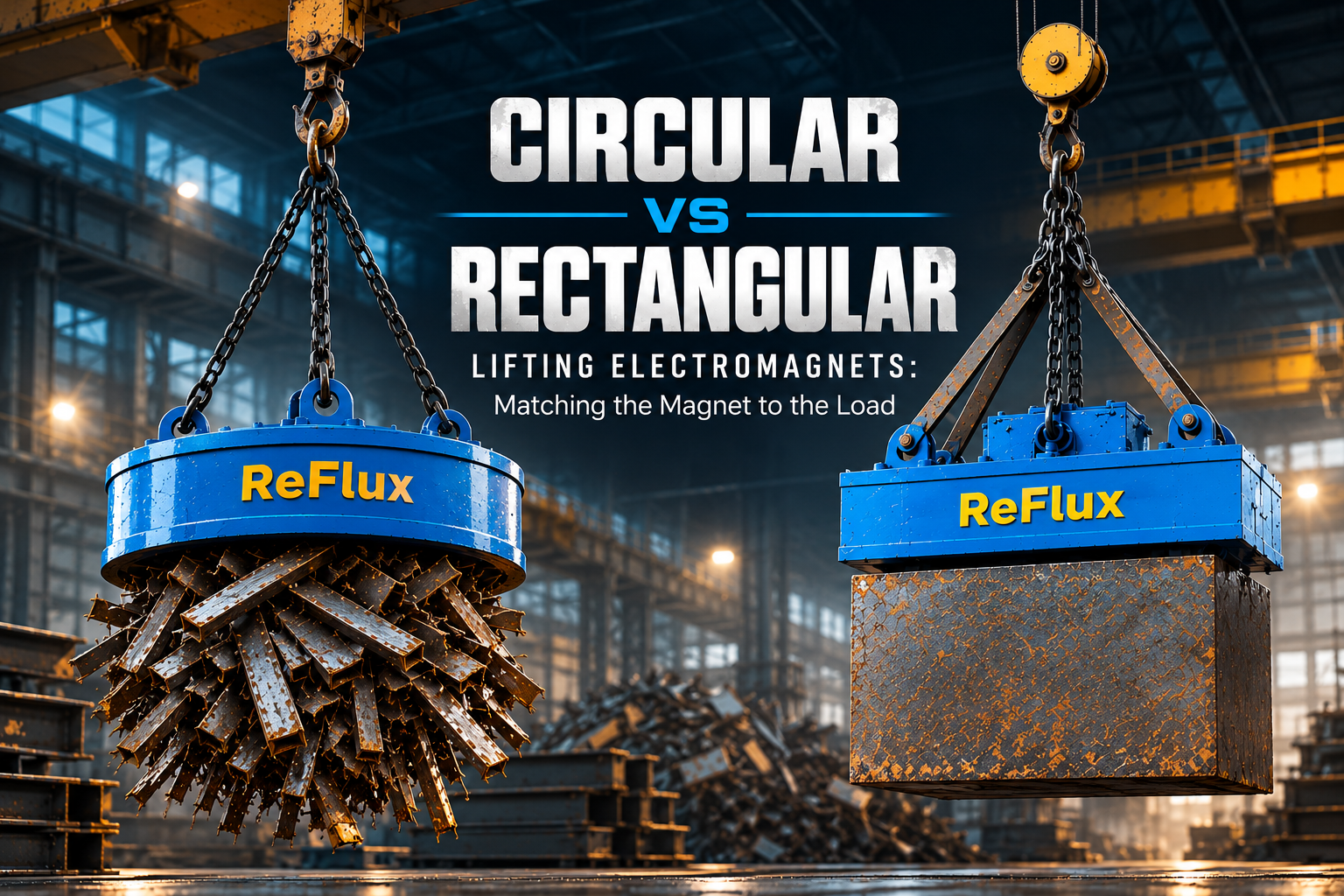
Buyers often start the lifting magnet conversation with a capacity number, “We need a 2-tonne magnet,” without first asking the question that actually determines performance: What shape is the load, and how does it sit under the magnet? Capacity ratings are tested under ideal conditions, flat mild steel, zero air gap, and full contact. Real loads rarely match that. The magnet’s shape, circular or rectangular, is what determines how close your real-world lift comes to that rated number.
Why shape matters more than the spec sheet
A magnet’s holding force depends heavily on contact area and air gap; the tiny gap between the magnet face and the load caused by scale, rust, unevenness, or curvature. The more of the magnet face that makes solid contact with flat load surface, the closer you get to rated capacity. Load geometry decides which magnet shape achieves that contact more consistently.
Circular lifting electromagnets: built for irregular loads
Circular magnets have no corners, which means they handle irregular, jumbled, or randomly stacked material far more predictably than a rectangular face would. This makes them the standard choice for:
- Scrap metal and mixed scrap piles
- Skulls and irregular castings
- Turnings, borings, and mixed-size ferrous material
- General-purpose lifting where load shape varies lift to lift
Considering scrap and irregular loads rarely offer full, flat contact, circular magnets are typically rated and selected with a working expectation well below their theoretical maximum. Experienced operators plan for this rather than treating the nameplate figure as a guarantee.
Rectangular lifting electromagnets: built for flat, stacked material
Rectangular magnets maximize contact area on flat, elongated, or stacked loads; the elongated face matches the geometry of the material far better than a circular face would. This makes them the better fit for:
- Billets and long bar stock
- Slabs and plate
- Pipes (with appropriate cradle or multiple-magnet setups)
- Stacked sheet or plate where multiple pieces need to lift together
On genuinely flat stock with good surface contact, rectangular magnets can approach their rated capacity more consistently than circular magnets do on irregular loads, simply because the contact assumption behind the rating is closer to reality.
The variable every buyer underestimates: thickness
Magnetic flux only penetrates so far into steel. Thin plate or sheet doesn’t offer enough material depth for the field to fully develop, which reduces effective holding force well below the rated capacity; sometimes dramatically. This applies to both shapes, but it catches rectangular-magnet buyers off guard more often, because plate and sheet handling is exactly where rectangular magnets are used. Always check a magnet’s capacity derating curve against your actual material thickness, not just the flat-steel maximum.
Why capacity ratings mislead buyers
The number on a magnet’s nameplate assumes: clean, flat mild steel; zero air gap; full face contact; adequate material thickness. Real-world lifts deviate from at least one of these on almost every job. A magnet rated for 3 tonnes on ideal flat steel might reliably handle far less on rusted, curved, thin, or irregular material. This is why matching shape to load geometry, not just chasing a bigger capacity number, is the decision that actually protects your lifting margin and your safety record.
How to choose
Start with your most common load, not your largest one. If daily handling is mixed scrap or irregular material, a circular magnet will give you more predictable performance across varied lifts. If you’re consistently moving billets, slabs, or plate, a rectangular magnet will make better use of its rated capacity. Many plants that handle both eventually run one of each rather than compromising on a single shape for every job.
Frequently Asked Questions
Which is better for scrap handling: circular or rectangular?
Circular lifting electromagnets are generally better for scrap, since their shape handles irregular, randomly stacked material more predictably than a rectangular face.
Can a rectangular magnet lift billets and slabs at its full rated capacity?
It can get closer to rated capacity than a circular magnet would on the same load, because the rectangular face matches flat, elongated stock more closely; nevertheless, material thickness and surface condition still affect actual holding force.
Why does material thickness affect lifting magnet capacity?
Magnetic flux only penetrates a limited depth into steel. Thin plate or sheet doesn’t provide enough material for the field to fully develop, reducing effective holding force below the rated maximum.
Do I need both a circular and a rectangular lifting magnet?
If your operation regularly handles both irregular material (like scrap) and flat stacked material (like plate or billets), running one of each shape typically gives better performance than compromising with a single magnet for every job.
Why doesn’t my magnet lift its full rated capacity in practice?
Rated capacity assumes clean, flat steel with zero air gap and full-face contact. Rust, curvature, thin material, or irregular load shape all reduce actual holding force below that number.