
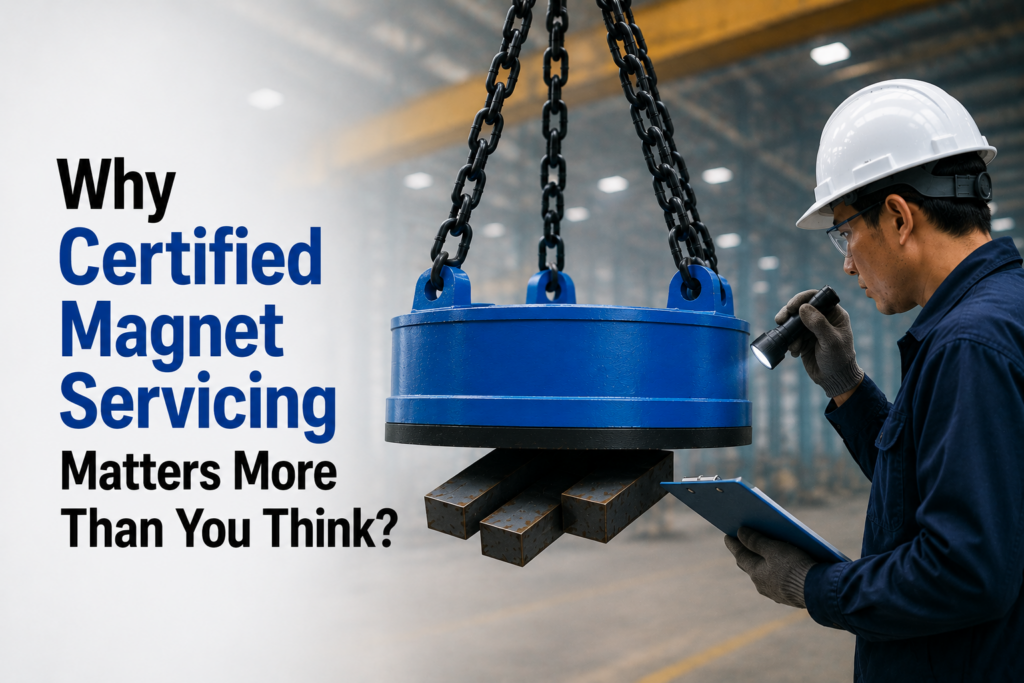
If you run a steel plant, scrap yard, cement facility, or any heavy industrial operation, your electromagnets are not just equipment, they are the backbone of your material handling. When they work, your production moves. When they don’t, everything stops.
Most plant managers understand the importance of keeping magnets running. What’s less understood, and far more critical than many realise – is the difference between getting a magnet “fixed” and getting it properly serviced by a certified specialist.
That difference can be the line between a plant that runs efficiently and one that faces repeated breakdowns, safety incidents, and mounting costs.
What Does “Certified” Actually Mean?
When we talk about certified magnet servicing, we’re referring to a structured process that goes well beyond basic repair. It means every job is carried out to defined technical standards, tested against measurable performance benchmarks, and validated before the equipment goes back into operation.
In practice, certified servicing includes:
- Load testing to verify actual lifting capacity in kilonewtons (kN)
- Voltage and duty cycle calibration to ensure safe, efficient operation
- Full inspection of coil windings, insulation, terminal connections, and housing
- Detailed service reports documenting what was found, what was done, and what was tested
- Warranty coverage on completed work — typically up to 12 months
This is fundamentally different from a local shop that rewinds a coil, does a basic visual check, and hands the magnet back. One gives you confidence. The other gives you uncertainty.
The Real Cost of Uncertified Servicing
It’s tempting to go with the cheapest or fastest option when a magnet goes down. Downtime pressure is real, and any solution that gets you back up quickly feels like the right call.
But uncertified servicing often creates a cycle of problems. A coil rewound with substandard insulation will overheat faster. A magnet returned without load testing may perform at 60–70% of its rated capacity, not enough for your actual lifting requirements but not obviously broken either. You’ll notice it in slipping loads, slower cycles, or another breakdown six weeks later.
Beyond operational costs, there is a safety dimension that cannot be ignored. An electromagnet operating below certified capacity in a scrap yard or steel plant is a serious hazard. Loads that slip or drop unexpectedly put workers at risk and create liability that no operation wants to face.
The short-term saving from uncertified servicing rarely holds up against the long-term cost of repeat breakdowns, reduced productivity, and potential safety incidents.
Industries That Cannot Afford to Cut Corners
Certified magnet servicing is not just good practice — for many industries it is a functional requirement.
- Steel plants run continuous production cycles where a single magnet failure can halt an entire line.
- Scrap yards operate excavator and circular magnets under extreme conditions — heat, dust, high duty cycles, that demand equipment performing to full specification.
- Cement and coal handling facilities use suspension magnets to protect downstream equipment from tramp iron. A poorly serviced magnet that misses ferrous contamination can cause catastrophic damage to crushers and conveyors.
- Demolition and construction sites depend on excavator magnets to safely handle heavy, irregular loads where any reduction in lifting force creates immediate risk.
In every one of these environments, the magnet is not a peripheral piece of equipment. It is central to safe, productive operations.
What to Ask Your Magnet Service Provider
Before handing your equipment to any service provider, these are the questions worth asking:
- Do you provide load-testing and kN validation after every service?
- Will I receive a written service and inspection report?
- What warranty do you offer on the work done?
- Are your technicians experienced with my specific magnet type?
- Can you support on-site if I have an issue after the service?
If a service provider cannot clearly answer all of these, that tells you something important about the quality of work you can expect.
Servicing as a Long-Term Asset Strategy
A well-serviced electromagnet does not just avoid breakdowns, it extends the usable life of the equipment significantly. Industrial electromagnets represent a substantial capital investment. Certified, periodic servicing is the most cost-effective way to protect that investment and defer replacement costs.
Think of it the way you would approach servicing any critical industrial asset, not as a reactive cost when something breaks, but as a planned investment in operational continuity.
Plants that build certified magnet servicing into their maintenance schedules consistently experience fewer unplanned stoppages, longer equipment lifespan, and better overall operational efficiency.
The Bottom Line
Certified magnet servicing is not a premium option reserved for large operations. It is the baseline standard that any industrial facility running electromagnets should demand from its service partners.
When your magnet is load-tested, validated, and returned with a warranty, you are not just getting a functioning piece of equipment. You are getting certainty, and in a heavy industrial environment, certainty is exactly what keeps your plant moving.