
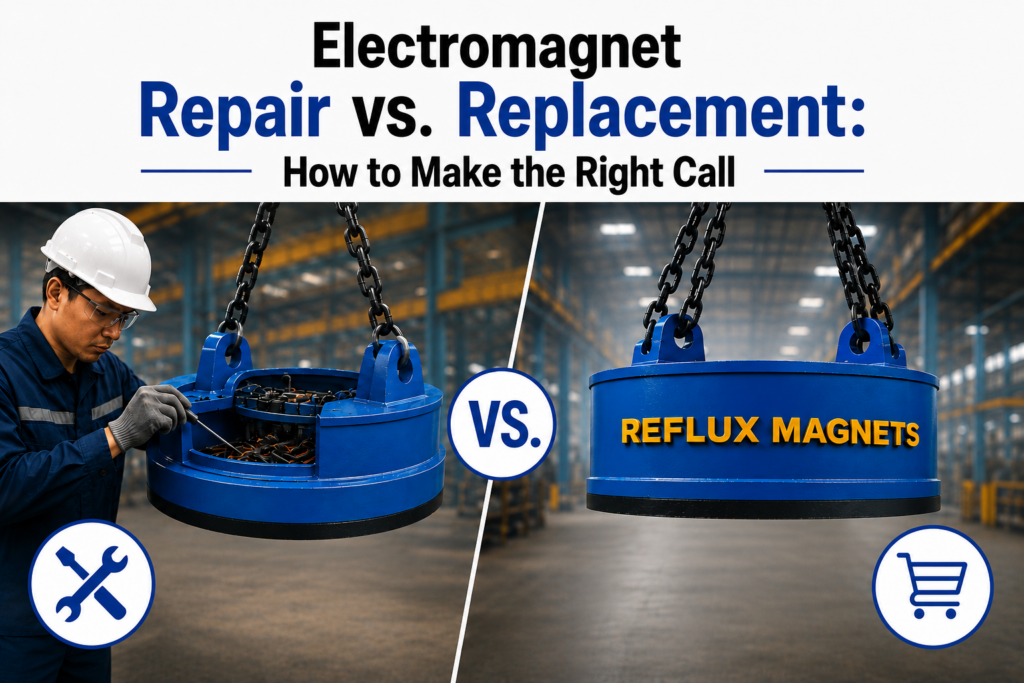
Your lifting magnet has failed. Production is halted. The pressure is on to get things moving again and fast. In that moment, the instinct for many plant managers and procurement heads is to immediately look at replacement. New equipment, clean slate, problem solved.
But those instinct costs Indian industry crores every year in unnecessary capital expenditure.
The repair vs. replace decision is one of the most consequential calls a maintenance or procurement team makes, and it deserves more than a gut reaction. Here is a practical framework to help you make the right call, every time.
Why the Default to Replacement Is Often Wrong
Replacement feels decisive. It signals that a problem has been permanently solved. But for industrial electromagnets, the numbers rarely support it as a first response.
A quality circular or rectangular lifting magnet can cost anywhere from a few lakhs to well over twenty lakhs depending on size, capacity, and type. A certified repair – even a comprehensive coil rewind and full refurbishment, typically comes in at a fraction of that cost, while restoring the equipment to full working specification with a warranty.
Beyond cost, there is the lead time to consider. A new magnet order often takes weeks. A properly resourced repair partner can have your equipment back in operation in 24 to 72 hours for most standard jobs, sometimes faster for urgent breakdowns.
When Repair Is Clearly the Right Choice
Repair makes strong operational and financial sense in the following situations:
- Coil failure or burnout: One of the most common electromagnet failures and almost always repairable through professional rewinding with heat-resistant insulation
- Insulation breakdown: Deteriorated insulation is a direct repair job that restores full performance when done correctly
- Terminal or junction box damage: Straightforward to rectify without affecting the core magnet assembly
- Reduced lifting capacity: Often caused by coil degradation or electrical issues, both of which are resolved through servicing rather than replacement
- Physical housing or face damage: Resurfacing and structural repair can extend equipment life significantly at low cost
- Equipment under ten years old: A well-built industrial magnet has a long service life; early replacement is almost never justified
In each of these cases, a certified repair restores the magnet to full working specification, load-tested, validated, and warrantied, at a cost that is typically 20 to 40 percent of replacement value.
When Replacement Genuinely Makes Sense
There are situations where replacement is the right answer. Being honest about these is just as important as avoiding unnecessary replacements:
- The magnet has been repaired multiple times in a short period: Recurring failures on the same equipment suggest a deeper structural issue that repair cannot sustainably resolve
- Core structural failure: If the magnet body, pole faces, or internal frame are severely damaged beyond what refurbishment can address, replacement becomes the more cost-effective long-term option
- Obsolete equipment with no parts availability: Very old magnets where compatible coil materials or components are no longer available may be better replaced
- Capacity mismatch: If your operational requirements have grown significantly and the existing magnet no longer meets your lifting needs, an upgrade makes sense
- Repair cost exceeds 60 to 70 percent of replacement cost, at this threshold, the financial case for repair weakens considerably, especially if the equipment is already older
A trustworthy service partner will tell you honestly when replacement makes more sense than repair. Be cautious of any provider who recommends repair in every situation regardless of the equipment’s condition.
A Simple Decision Framework
When your magnet goes down, run through these four questions before making a call:
- What is the nature of the failure? Coil, insulation, and terminal failures almost always favour repair. Structural failures need closer evaluation.
- How old is the equipment and how many times has it been repaired? A magnet with one previous repair and a coil failure is a strong repair candidate. One with four repairs in two years warrants a harder look.
- What is the repair cost as a percentage of replacement? Below 40 percent, repair is almost always the right call. Above 60 percent, replacement deserves serious consideration.
- What is your lead time requirement? If you need to be operational in 48 hours, replacement is rarely a realistic option. A capable repair partner is.
Running through this framework takes ten minutes and can save your operation significant money and downtime.
The Role of a Diagnostic Assessment
The most reliable way to make this decision is through a proper diagnostic assessment from a qualified service provider before committing to either path.
A good diagnostic covers the full condition of the coil, insulation, terminals, housing, and mechanical components, and gives you a clear picture of what needs to be done, what it will cost, and what you can expect in terms of equipment life post-repair.
Armed with that information, the repair vs. replace decision becomes straightforward rather than a guess made under pressure.
The Bottom Line
For most electromagnet failures, repair is the faster, more cost-effective, and operationally smarter choice. Replacement has its place, but it should be a considered decision, not a default reaction to downtime pressure.
The best industrial operations treat their electromagnets as long-term assets – maintained, serviced, and repaired to specification, rather than consumables to be swapped out at the first sign of failure. That approach saves money, reduces downtime, and keeps production moving.