
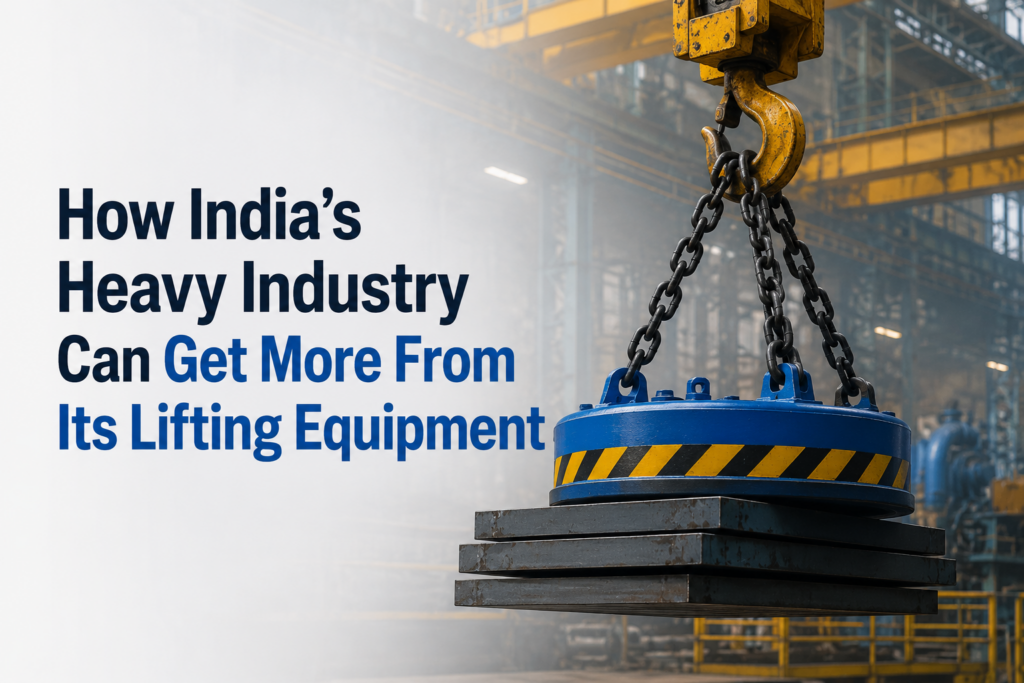
India’s heavy industry is growing faster than at any point in the last two decades. Steel production is scaling. Scrap processing volumes are rising. Infrastructure projects are multiplying. And at the centre of all of it — keeping materials moving, lines running, and operations productive, is lifting equipment.
But here’s what most plant teams don’t talk about: the gap between what their lifting equipment is capable of and what they’re actually getting out of it is often significant. The good news is that closing that gap doesn’t require new equipment or major investment. It requires a different approach to how existing equipment is managed.
Understand What Your Equipment Is Actually Capable Of
Most industrial electromagnets are rated for a specific lifting capacity in kilonewtons. In practice, many operate well below that rating — due to coil degradation, insulation wear, or calibration drift that builds up quietly over time.
The first step to getting more from your lifting equipment is knowing what it’s actually delivering versus what it should be delivering. A load test gives you that answer clearly and quickly. If there’s a gap, it can almost always be closed through servicing rather than replacement.
Stop Treating Maintenance as a Reaction
The single biggest productivity drain in heavy industry isn’t equipment failure — it’s unplanned downtime caused by equipment failure that was preventable.
When a lifting magnet goes down unexpectedly, everything stops. The line. The labour. The output. And the cost isn’t just the repair — it’s every hour the plant isn’t producing while the problem gets sorted.
Plants that schedule annual servicing, act on early warning signs, and treat maintenance as a planned cost rather than an emergency response consistently run with fewer stoppages and lower overall maintenance spend. It’s not a complicated shift — it’s a deliberate one.
Match the Equipment to the Job
Not every electromagnet is suited to every application. A circular lifting magnet designed for scrap handling behaves very differently from a rectangular magnet built for slab and billet lifting. Using the wrong type for your application means working harder for worse results.
The same applies to magnetic separators. The right separator for a high-volume dry material process looks very different from what’s needed for a liquid or slurry application. Getting this match right — ideally with guidance from a specialist who understands both the equipment and the application — directly improves throughput and reduces wear on the magnet itself.
Extend Equipment Life Through Smarter Operation
Two operating habits destroy electromagnet life faster than anything else: exceeding the rated duty cycle and ignoring overheating.
Duty cycle refers to the ratio of on-time to off-time during operation. Exceeding it causes the coil to build up heat faster than it can dissipate — breaking down insulation, degrading the coil, and shortening the magnet’s operational life significantly.
Keeping an eye on operating temperatures, respecting duty cycle limits, and ensuring the magnet is being used within its rated capacity are simple habits that add years to equipment life and reduce the frequency of major repairs.
Consider the Full Lifecycle — Not Just the Purchase
Heavy industry teams often evaluate lifting equipment purely on purchase price. The smarter measure is total cost of ownership — what the equipment costs to run, maintain, and eventually replace over its full operational life.
A well-maintained electromagnet, serviced annually and operated correctly, can deliver reliable performance for well over a decade. One that’s run hard, serviced reactively, and pushed beyond its rated limits will cost significantly more in repairs, replacements, and lost production over the same period.
Building lifecycle thinking into procurement and maintenance decisions — considering repair, refurbishment, and rental options alongside outright purchase — consistently delivers better outcomes financially and operationally.
The Bottom Line
Getting more from lifting equipment isn’t about spending more. It’s about operating smarter — knowing what your equipment is actually delivering, maintaining it on a planned schedule, matching it correctly to your application, and thinking about its full lifecycle rather than just its upfront cost.
India’s heavy industry has an opportunity to significantly improve productivity and reduce operational costs simply by changing how it manages the equipment it already has. The plants that figure this out first will have a meaningful and lasting advantage.
Reflux Magnets provides certified electromagnet servicing, coil rewinding, rental, and lifecycle management for heavy industries across India. Every job is load-tested, documented, and backed by up to 12 months warranty with pan-India on-site and pickup support.
Visit refluxmagnets.com or reach out via WhatsApp to discuss your equipment requirements.